Recording
Watch the Ceremony
A recording of Pat's funeral ceremony, held at St Alban Woodland Burial Ground on 10th March 2026.
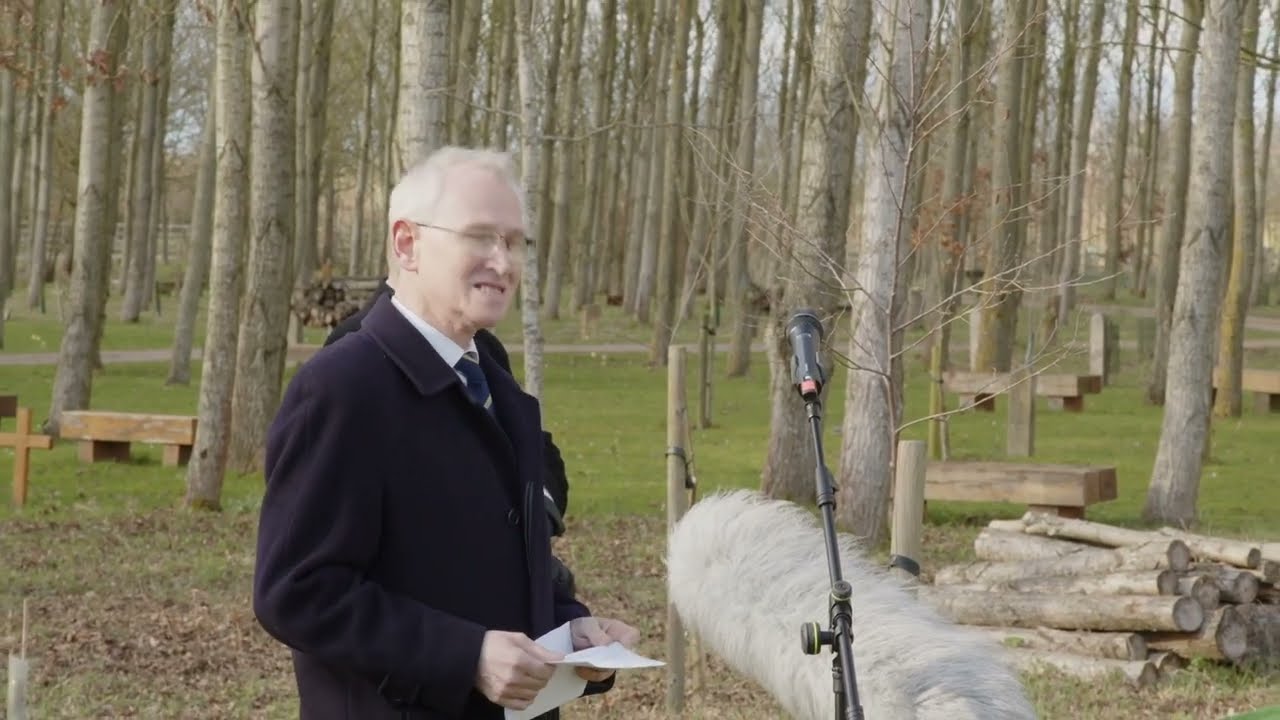
Click to watch on YouTube · youtu.be/T88U0cW7kQE
A Celebration of Life
"I would like my funeral to be a celebration of the life of someone who has had the greatest of good fortune."
— Pat McKeown, 2003
Recording
A recording of Pat's funeral ceremony, held at St Alban Woodland Burial Ground on 10th March 2026.
Click to watch on YouTube · youtu.be/T88U0cW7kQE
Presentation Script
The presentation script for Pat's funeral, read by Caroline Clark, Humanist Celebrant accredited by Humanists UK.
16th August 1930 – 10th February 2026 · St Alban Woodland Burial Ground, Keysoe, Bedfordshire
On behalf of Mary, Jonathan, Jeremy, Nick and all the family, may I welcome you all to this celebration of the life of Pat McKeown, in this beautiful place. My name is Caroline Clark and I'm a celebrant accredited by Humanists UK.
We will begin our ceremony today with a few words about life and humanism, then we will have a tribute to Pat, including contributions from his colleague Professor Paul Shore and from his son, Jonathan. Our ceremony will also include three pieces of music, chosen for today by Pat himself.
We follow that with a moment of quiet reflection where we will also listen to another piece of music. Then we will make our final farewells to Pat. Our ceremony will be non-religious and therefore there won't be any hymns or prayers, but those of you with a religious faith may wish to say a silent prayer during the moment of quiet reflection.
Pat was a committed humanist. He and Mary were members and strong supporters of the British Humanist Association, known now as Humanists UK — and that is why I, as a Humanist Celebrant, am conducting today's celebration of his life. Humanists UK is the national charity working on behalf of non-religious people who seek to live ethical and fulfilling lives on the basis of reason and humanity. You can read about Pat's views and reasons, his 'belief system', in the "Personal" section of his website (www.patmckeown.co.uk).
In brief, humanism, which can be said to pre-date Christianity, is based on seeking to live a good life, to exercise altruism and safeguard our planet, all based on rationality and science and the scientific method, with no belief in the supernatural.
Pat's favourite word in the English language was altruism; there is clear evidence that an act of kindness prompts others to do likewise. It is synonymous with love of your fellow humans. Humanists are in accord with those of religious belief who aim to do good and that is why all are so warmly welcome at this celebration today.
Humanism also embraces the knowledge that this is the one life we have. Death is the end of life and being dead is no different to not being born. This can sound cold and heartless but it isn't, it is actually very liberating. It makes you look at life, value it, really value it — value your family, value your friends and use the time you have to try to optimise your contribution to people and our world. We know that Pat valued his life, because he told us so, and from what you all know of him as your family member or friend.
We say that death is normal, it's natural; you cannot have life without death. I know that doesn't make it any easier when we lose the people we love. That is never going to be easy. Love is the bond that ties us together and the breaking of that bond is the hardest thing we have to face.
However, we know that the dead person lives on in our memories and in the memories of everyone who has known them. They live on too, in the genes they have passed on, and in the ideas they have shared, too. No one in this world fails to make an impact in some way and when someone has made a significant contribution to engineering and science as Pat has done, then they live on in that contribution to making the world a better place.
Pat's father, Robert Matthew McKeown, known as Bob, came from a Northern Irish family; the eldest of 12, he was born in London. Pat's mother, Bessie Augusta (Gus) White was born in Bristol. They met in Weymouth and married in 1928. Pat was born in August 1930 (and his brother Peter in 1938).
Bob had left the RAF and joined the Handley Page aircraft company initially at Cricklewood specialising in flight engineering and inspection. As he took more and more responsible jobs within the aircraft industry (and later, the Air Ministry) they moved home several times: Coventry, Prestwick, Cambridge, Bristol and Weybridge.
Shortly after surviving the World War II blitz on Coventry in November 1940, they moved to Prestwick in Scotland where Bob was responsible for receiving, and preparing for active service, American bomber aircraft which had flown across the Atlantic. All these had to be flight tested and Pat remembers his first ever flight at about 11 years old in the tail turret of a Liberator bomber, over the Firth of Clyde to Ailsa Craig and back — a truly memorable experience, he said.
In late 1944, Pat moved with the family to Cambridge and went to the Cambridge and County High School for boys; then in 1947 on to Bristol where his father was appointed Chief Inspector of the government Aeronautical Inspection Directorate overseeing all quality aspects of aircraft manufacture at Bristol Aircraft Company. These included the mighty but flawed Brabazon airliner, the maiden flight of which Pat and Mary watched.
Pat was now in the 6th form of Bristol Grammar School which he enjoyed; he played rugby in the 1st XV, became captain of athletics and sergeant major of the Combined Cadet Corps. This was the time he went with friends to a party and met a young woman called Mary Heath… and the rest, as they say, is history… "glorious history", he said.
He regretted that he didn't work as hard at his studies as he should because he failed his University entrance exams — an event which he credited with giving him a very big and ultimately beneficial shake-up.
Pat undertook his obligatory National Service, from 1949 to 1951, serving with the Royal Engineers at Marchwood military port near Southampton. This gave Pat interesting experience in shipping and port handling techniques – and some excellent sailing on the Royal Engineers' fleet of regimental yachts.
After his National Service Pat signed up to the Royal Army Reserve of Officers (RARO) and joined the Bristol Aircraft Company as a student apprentice. As well as practical, on the job training, he went to college on day release and night school to gain academic knowledge. He worked as an engineering designer and was in at the beginning of ground-breaking work on guided missiles which included new research into the dynamics of structures.
In 1954 Pat gained a national state scholarship, which his managers at Bristol Aircraft Company said he should take, at the College of Aeronautics at Cranfield. Here he undertook an intensive 2-year MSc in Aircraft Design, Aerodynamics, Propulsion systems, Materials and Production Engineering. It was also in 1954 that Pat and Mary married, in Bristol.
The young couple needed somewhere to live near Cranfield. Mary came from a Methodist family and a kindly minister in Wolverton found them low-cost accommodation above a shop opposite the old British Railways works. A friendly local bank manager and his wife allowed them to use their bath because the flat didn't have one.
While Pat was studying, Mary worked at Sogenique, the Newport Pagnell subsidiary of GSIP, a Swiss machine tool manufacturer based in Geneva. In 1956 Pat obtained his MSc and also went to work for Sogenique as a measuring machine specialist, supporting the sales and service side of the business.
Pat was still a Lieutenant in the Reserves and although he'd been at Sogenique for only two weeks he was called up to take part in the British, French and Israeli invasion of Egypt – which we now know as the Suez crisis. This earned him the nickname of "two-week wonder" from his new colleagues. By now Mary was pregnant with their first son, Jonathan.
Pat's Suez adventure involved him landing with the invasion force at Port Said and setting up a base from which to operate the port. Suez ended in a humiliating defeat for Britain, the end of any claim we had to be a world power. Pat wrote a fascinating and somewhat scathing monograph about his experience which he lodged with the National War Museum. You can read this on his website.
After returning from Suez, Pat resigned his commission and returned to work at Sogenique for the next 13 years. During this time he worked in both Newport Pagnell and Geneva, designing bespoke measurement equipment. An example is a machine named Galaxy, commissioned by the Royal Observatory Edinburgh in the early 1960s, which determined from star field plates taken over many years whether the universe was expanding.
It was at GSIP that Pat developed methods of defining the real accuracy of machine tools which led eventually to the 3D error-mapping and software error compensation that lie at the heart of today's machine tools worldwide.
In 1968 Pat went to work under Professor John Loxham at the Cranfield Institute of Technology. They managed to obtain one third of the total MinTech funding available — quite a coup! This was used to set up the Cranfield Unit for Precision Engineering. Within a year Professor Loxham retired and Pat was running the unit, which went on to design, construct, commission and supply worldwide a wide range of ultra-precision machine tools and metrology equipment.
Pat went on to be visiting professor at the University of California Berkeley, the University of Wisconsin Madison, and Nanjing University of Aeronautics in China. He led professional development short courses here and around the world, including Singapore, Australia, Taiwan and the USA.
In 1999, Pat became the founding president of the highly successful European Society for Precision Engineering and Nanotechnology, euspen, which has its headquarters at Cranfield and now has approximately 1,000 members in 27 countries.
Pat received lifetime achievement awards from the precision engineering societies of America, Japan and Europe, and was awarded the Georg-Schlesinger Preis from the State of Berlin in 2007. He was awarded the OBE for work in the development of high precision engineering in 1991, and the Faraday Medal by the Institution of Electrical Engineers in 1999.
Professor Pat McKeown, OBE, Fellow of the Royal Academy of Engineering has made enormous contributions to our daily lives through the advancement of precision engineering. He was undoubtedly the World's most respected and recognised precision engineer of his time. The impact of his work, and that of the engineers he developed, was, and is, enormous. I'm honoured to be able to talk about him today.
Amongst many things Pat mentored me in public speaking. He advised me "to keep it upbeat and keep the audience engaged"— I will do my best.
Professionally speaking Pat McKeown was many things: a precision engineer, a professor, an innovator, a business founder, a business leader and a builder of an international community. Pat excelled in the broadest sense.
Pat's charm combined with his deep technical expertise equipped him in a unique way to gain people's confidence. These attributes made him super effective in establishing Cranfield as the global centre of excellence in precision engineering. Under Pat's leadership Cranfield and later its precision engineering spin-outs thrived. Working for Pat was tremendous, though it came with a notable level of expectancy.
Pat was determined; he revelled in advancement and the challenges of making things that much better. He never expected his team to work harder or longer than he did himself – though that was a high bar. Pat was a wise manager, an incredible mentor; he gained people's trust and their dedication.
Pat's senior management team included a "straight-talking" Lancashire chap (Bill Wills-Moren) and reflective "deep thinkers" from Northants who did remarkable things yet with few words (Geoff Portas). Pat was super generous with his time. Many mentored by Pat became renowned precision engineers. As Keith Carlisle commented: "Pat used his skills to elevate others".
As UK industry started to struggle in the later part of the 1970s, Pat focused on developing activity in the US. He would walk into blue chip companies like IBM, Kodak and 3M, and secure major international contracts to design and build super complex machines at Cranfield. Pat was also a super salesman.
Alongside all this industrial research, Pat established himself as the world's leading Precision Engineering Professor. He became President of the International Institute of Production Research (CIRP) — a highly prestigious position. And I know Mary, your tremendous support made Pat's leadership of CIRP possible.
euspen will celebrate its 26th International event in Poland this June. Just think about it — Pat McKeown's post-retirement project has run for over a quarter of a century. And it looks well established to continue for many years.
So, this brings me to close with some of the impact from Professor Pat McKeown's work:
As a Humanist, perhaps Pat was not looking to build disciples, though he gained many followers. I'm proud to be one.
To see friends and family here — including those who have travelled from so far afield; from the US, Turkey, Germany, from all points of the compass and at considerable effort — that would delight Dad. As it delights Mum, Jeremy, Nick and me. We are so pleased you are all here, and know that those who couldn't make it are thinking of Dad right now.
Dad was a great engineer. And also an amazing Dad, Grandpa and Great Grandpa. His most-used phrase — almost a catchphrase and used extensively both at work and at home — was "Good for you!"
For me and my wonderfully competent brothers, Jeremy and Nick, every ball well caught, spelling test passed, recorder tune butchered, width swum, times-table learnt, bully stood up to or tooth extraction survived; any achievement or milestone reached, and every adversity overcome, however small, prompted an enthusiastic "Good for you!" from him.
This continued past our taking the stabilisers off bikes, to bringing girlfriends home for tea, to exams passed, exams not quite failed, exams failed but come to terms with, studies, jobs, marriages and children. This was no mere parenting gambit at home; no management policy at work. It was just his deep-seated generosity of spirit and delight in the successes, the fulfilment of others.
When first his youngest son, Nick, and then his eldest grandson, Sam became engineers, Dad's pride knew no bounds.
When our Sam and Susi were little, Dad would often call in unannounced to our home en route home from work in the early evening, standing besuited and bright-eyed on the doorstep wanting to come and play with Sam and Susi before their bedtime. "Can Sam and Susi play?" he'd ask with a wink. They were his first grandchildren, of whom he was immensely proud — just as he was of each of his subsequent seven grandchildren; Roshan, Ben, Bex, Matt, Jessica, Zoe, Olive and his two step grandsons, Jacob and Luke; his daughters-in-law who all loved him — and were loved by him — deeply; and his six great-grandchildren, Romy, Max, Teddy, Ella, Lucy and Nico.
The only less than charitable things I ever heard Dad utter were about over-privileged and under-compassionate people in public life. And — at least partly in jest — about horse-racing, when it occasionally supplanted rugby on TV.
For much of the last 40 years we have been a scattered family; at times spread over three or four different continents. Dad was always the force behind arranging family get-togethers. Venues were booked, meals ordered, hotels booked, hikes mapped out — often months in advance. It was hard to decline, but always a joy once accepted. He pulled everyone together. Someone had to.
And he's drawn a great crowd again, today. Dad, Good for you!
His best and longest-standing friend and fellow humanist, David Radford, sadly died some 12 years ago. The two of them always seemed able to spark laughter in each other by some arcane chemistry. To paraphrase David's son Julian: while one might sentimentally entertain the possibility that Dad and David are now having a belly laugh together again, both David and Dad would pooh-pooh such unscientific nonsense. Unless, of course, they are.
First, he'd want to know that his wife of 71 years, Mary, our incredible Mum, Grandma and Great Grandma, is happy, safe and free to enjoy her life, her garden, her books and her family, and that she is supported by all our love. Well, she is.
He would want any tears here to be tears of joy for a life well lived. He would be firm about that.
He'd want the news from all of you wonderful people — family and friends — about your lives, your work, your travels and your hopes and plans for the future. And if you see someone here and you wonder what their connection was to him, he'd expect you to approach them and ask, to find out, to engage and enjoy, to discover, learn and delight in. He'd want us all to connect and re-connect, to swap stories and news — about him, yes of course, but mostly about all of us.
And the England rugby team.
Dad did not believe in an afterlife. He understood that death simply — and wonderfully — means a redistribution of matter into everything. It is in all of us that his presence will remain.
Dad! GOOD FOR YOU!
I will end this tribute with some words that Pat wrote himself.
Let us now have a few moments silence, for each of you to be with your own special memories of Pat, fond and happy ones I'm sure. Those of you with a religious faith may wish to say a silent prayer.
We have now come to the part of our ceremony when we will say our final goodbye and commit Pat's body to this special ground. I invite those of you who wish to and are able, to join me and the family now by the graveside.
Here, in this beautiful place, Pat will now rest in peace. We dedicate this plot, which he and Mary chose together, amid these natural surroundings, to every precious and treasured memory of Pat.
Pat knew and experienced love and friendship. He will always be your husband, your Dad, your Grandpa, your Great Grandpa, your brother, your uncle, your father-in-law, your colleague, and your friend. As long as you keep him in your hearts, that will hold true.
Pat will be part of this place for all time. Through the warmth of summer and the cold of winter; through the freshness of spring and the mists of autumn. He will be at peace.
Death ends a life but not a relationship. When someone we love dies, like Pat, it's natural for us to grieve them and to miss the constancy of their presence in our lives. Grief, it is said, is the price of our love.
And it is your love that will keep his presence alive. He will be there in your thoughts and your memories, in your shared experiences, in the way you lead your lives because of the enduring influence he had on you. Find ways to honour him that you know he would love, and speak of him often. He will always be with you.
Please take the time you need here, and when you are ready, we will make our way to the Fox and Hounds in Riseley for the second part of today's ceremony — the celebration of Pat's life. There will be refreshments and plenty of time for people to share their thoughts and memories of Pat, either individually or to the group. Pat's grandchildren will be making their contribution to start you off, and all are welcome to share.
Thank you all for coming here today to help us celebrate the good life of Pat McKeown. Go in peace, friendship and fellowship with each other, and remember that what will survive of us is love.